
Stage 01 · Week 1
Feasibility Review and Costing
The OEM process begins when the buyer shares technical drawings — PDF, DXF, DWG, or 3D CAD in STEP/IGES format — and the manufacturing team reviews them for production feasibility. The review looks at material selection implications, tooling complexity, finish requirements, dimensional tolerances, and packaging configuration. This stage typically takes 3–7 days.
At the end of feasibility review, the manufacturer responds with: confirmation of production feasibility (or flagged design issues that need resolution), proposed material specification, estimated tooling cost, estimated per-unit production cost at the buyer's target MOQ, and an end-to-end lead time estimate. This forms the OEM commercial proposal.
12-16wk
Total OEM lead time
14-40d
Tooling fabrication
3-7d
Feasibility review
1,000+
Typical first OEM run
Stage 02 · Week 1-2
Material Selection and Approval
Material selection happens in parallel with feasibility. The manufacturer recommends an alloy specification appropriate to the product function — typically CZ121 / CW614N brass for decorative and functional hardware, 6063-T6 aluminium for extruded sections, ZAMAK 3/5 zinc alloy for stamped or pressure-cast parts, or SS304/SS316 stainless for corrosion-critical applications.
For buyers with specific brand or technical material preferences (lead-free brass for US drinking-water-adjacent applications, antimicrobial copper-alloy variants, or specific density specifications for premium tactile feel), the manufacturer confirms feasibility and any cost or lead-time implications. Material specification is locked at this point and becomes a contractual reference for all subsequent stages.
Stage 03 · Week 2-7
Tooling Design and Fabrication
Tooling is where OEM differs fundamentally from catalogue or private label production. The manufacturer's tool room or appointed die shop produces the casting die, machining fixtures, or stamping tools required to make the buyer's specific product. This is a one-time investment that the buyer typically funds, and which then enables economical repeat production.
Tooling lead time depends on product type and tooling complexity. A single-cavity gravity die for a brass lever handle typically takes 14–21 days. Pressure die casting tooling for a zinc alloy part runs 25–40 days. Forging dies are similar. Multi-cavity tooling, common where production volumes justify it, extends fabrication time but reduces per-unit production cost.
Tooling Ownership Structures
- →Buyer-owned tooling — buyer pays, owns, tooling held at factory for production
- →Use-rights tooling — buyer pays for use, manufacturer retains formal ownership
- →Volume-commitment co-invest — manufacturer absorbs tooling cost against forecast orders
- →Hybrid amortisation — tooling cost split across first 3-5 production runs in unit price
Stage 04 · Week 7-8
First-Article Sample Production
Once tooling is fabricated and proven on a test casting or machining cycle, the manufacturer produces a small batch of first-article samples — typically 5–20 pieces depending on product. These are produced through the full intended process: casting/forging, machining, finishing, and assembly.
First-article samples are dispatched to the buyer by DHL or FedEx, with transit times of 3–5 days to most major buyer locations. Sample dispatch typically includes measurement data sheets, finish specification confirmation, and any tooling-related observations the manufacturer identified during the proving run.
Stage 05 · Week 8-10
Sample Approval and Sign-Off
Sample review at the buyer's end typically takes 5–14 days. The buyer assesses material weight, finish consistency, dimensional accuracy, mechanical function, packaging configuration, and any aesthetic considerations. Sign-off is provided in writing — usually a counter-signed sample approval document — and this approved sample becomes the contractual reference for bulk production quality.
If the sample fails any criterion, the manufacturer makes corrections — either tooling adjustments, process changes, or finish refinements — and produces a revised sample. Most OEM projects achieve approval on the first or second sample iteration; complex products may require three rounds. Each iteration adds 2–3 weeks to the timeline.
Stage 06 · Week 10-13
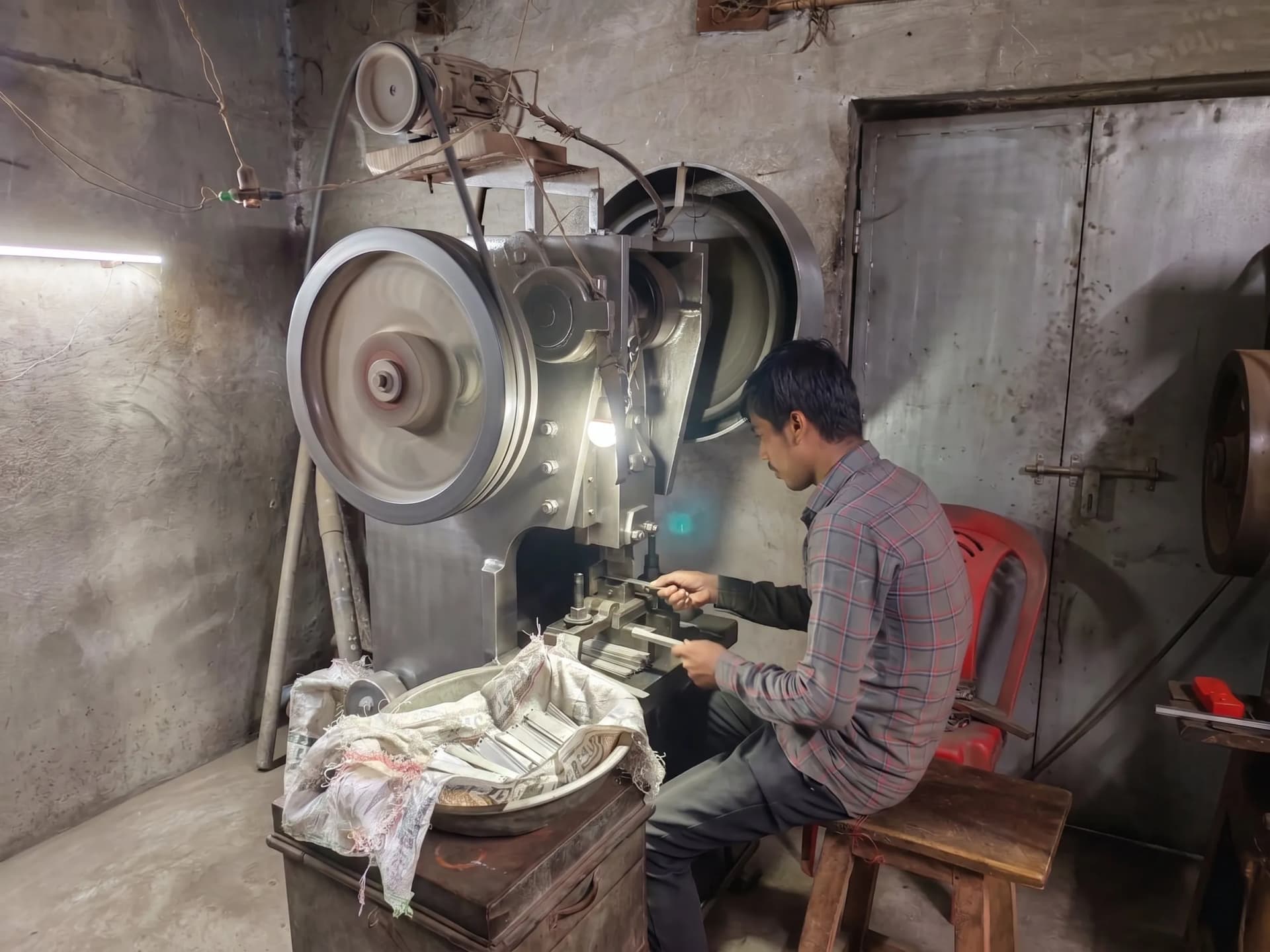
Bulk Production Run
Bulk production begins once the buyer signs off on the approved sample and the 50% production advance has been received. Production sequencing typically runs: casting/forging the substrate, machining to dimensional specification, primary finishing (polishing or grinding), electroplating or PVD coating, secondary finishing (antique treatments, lacquering), assembly, and final inspection.
For a typical 2,000–5,000 piece OEM run, bulk production takes 18–28 days. Larger runs scale broadly linearly. Throughout production, the manufacturer should share periodic progress updates — typically weekly photos of pieces at various stages and a confirmed mid-production delivery date.
Production Phase 1
Substrate manufacture — casting, forging, or stamping. Material conformance check at this gate.
Production Phase 2
Machining, drilling, and dimensional finishing. First in-process AQL gate against approved sample.
Production Phase 3
Finishing — polish, plate, PVD, antique treatment, lacquer. Visual gate before assembly and pack.
Stage 07 · Week 13-14
Multi-Stage Quality Control
Quality control runs throughout production, not just at the end. The standard OEM QC structure is: in-process inspection at three production gates (substrate, post-machining, post-finishing), pre-packing AQL inspection against the approved sample, and pre-dispatch documentary inspection before shipment. AQL 2.5 is the typical specification; AQL 1.5 is used for premium and hospitality work.
At pre-packing inspection, the manufacturer's QC team pulls AQL sample sizes (typically 32, 50, or 80 pieces per lot depending on lot size and AQL level) and physically inspects each piece against finish, dimension, weight, and function criteria. The inspection report — with defect classification and photographs — is shared with the buyer.
Buyers commissioning third-party AQL inspection (SGS, Bureau Veritas, Intertek, TUV, AsiaInspection) typically schedule inspection during this stage. Manufacturers expect and accommodate third-party inspection on OEM work.
Stage 08 · Week 14-15
Packing, Labelling, and Pre-Shipment Inspection
Packing for export hardware uses individual poly bags or tissue wrapping for finish protection, inner cartons (typically 10–25 pieces), and 5-ply export master cartons (typically 100–500 pieces per master) with buyer-specified labelling, country-of-origin marking, and master carton barcoding.
Private label OEM buyers add their own retail packaging, brand artwork, EAN/UPC barcoding, multi-language regulatory inserts, and any market-specific labelling at this stage. Pre-shipment inspection (PSI) — final photo and video documentation of packed cartons before dispatch — is shared with the buyer for release approval before the balance payment is requested and the goods leave the factory.
Stage 09 · Week 15-16+
Export Documentation and Freight Dispatch
Once the balance payment clears, goods move from the factory to the appointed freight forwarder for export handling. The full export documentation set comprises: commercial invoice, packing list, Bill of Lading or Airway Bill, Certificate of Origin (and CEPA/AI-ECTA/GSP-specific variants where applicable), QC inspection report, fumigation certificate (for wood-packed shipments), and any market-specific certifications.
Sea freight typically routes through JNPT Mumbai (Nhava Sheva) or Mundra port, with weekly direct services to Felixstowe, Southampton, Rotterdam, Hamburg, Jebel Ali, Sydney, Melbourne, Mombasa, Durban, Halifax, and Long Beach. Air freight routes through IGI Delhi with daily cargo capacity to all major hardware-import markets. Transit times vary by destination: 18–22 days to UK and EU (sea), 5–7 days to UAE (sea), 18–26 days to Australia (sea), 22–35 days to Canada (sea), 3–5 days globally (air).
Commercial Invoice
Itemised, HS-coded, signed and stamped. Provided in 3-5 originals plus buyer copies.
Packing List
SKU-level breakdown per carton, master/inner counts, dimensions and weights for customs.
Bill of Lading / AWB
Freight carrier's shipment document. Required to release the cargo at destination port.
Certificate of Origin
Confirms India origin. Required for preferential duty under CEPA, AI-ECTA, GSP schemes.
Inspection Report
AQL conformance, defect classification, photographic evidence. Pre-dispatch.
Market-Specific Certificates
Fumigation, REACH compliance, material composition certificates as required by destination.
FAQ
Frequently Asked Questions
How long does the full OEM process take?
Typically 12–16 weeks end to end from drawing approval to dispatch — feasibility (1 week), tooling (3–6 weeks), sampling and approval (2–3 weeks), bulk production (3–4 weeks), QC and packing (1–2 weeks). Sea freight transit then adds destination-dependent time.
How long does OEM tooling take to make?
Single-cavity gravity die for a brass handle: 14–21 days. Pressure die casting tool: 25–40 days. Forging dies similar. Multi-cavity tooling extends fabrication but reduces per-unit production cost.
Who owns the OEM tooling?
Specify in the OEM agreement. Common structures: buyer-owned and held at factory; use-rights with manufacturer retaining formal ownership; volume-commitment co-invest; or amortised across first 3–5 production runs in unit price.
What happens if the first-article sample fails?
The manufacturer makes corrections — tooling adjustments, process tweaks, or finish refinements — and produces a revised sample. Most OEM projects achieve approval on first or second iteration. Each iteration adds 2–3 weeks.
Can I commission third-party inspection on OEM production?
Yes — this is standard for OEM work. Major inspection firms (SGS, Bureau Veritas, Intertek, TUV) operate in Aligarh and inspect against the approved first-article sample. Schedule inspection during the QC stage before packing.