
Category Overview
The Railing Fittings Specified for Commercial Projects
Commercial railing hardware is a broad category. A single staircase or balustrade specification can list a dozen SKUs — and a hotel project, a multi-storey commercial building, or a hospitality fit-out can easily carry over fifty unique component lines across several floors. Knowing which components belong in your RFQ is the first step toward an accurate quote.
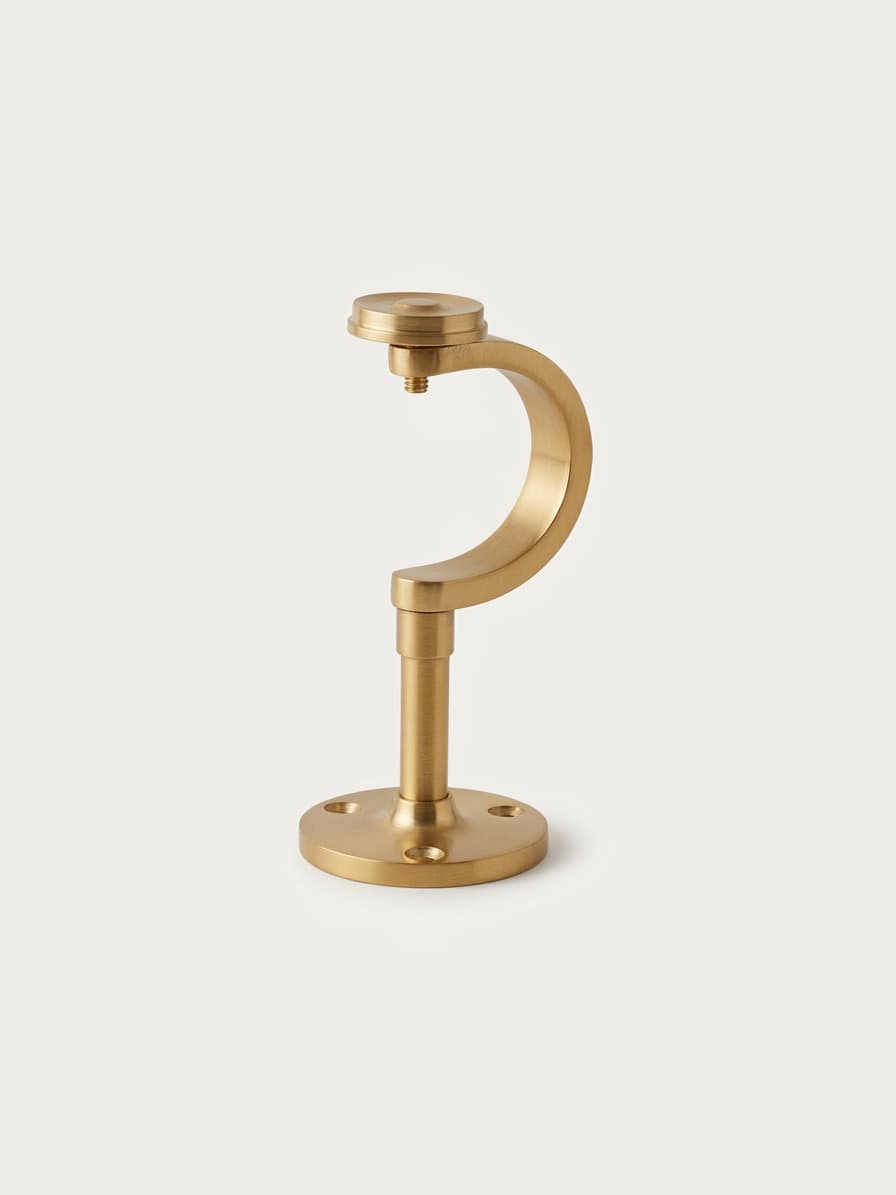
Across the projects we supply from Aligarh, the components that recur most often are: top mount and side mount balusters, glass clamps and spigots, base flanges, elbow joints, end caps, wall brackets, handrail brackets, post fittings, joint sleeves, and decorative caps and rosettes. Stair-specific fittings — newel posts, volutes, mitre couplers — are almost always tooled to the architect's drawing rather than picked from a catalogue.
100
Pieces — typical bracket MOQ
30+
Standard SKUs in catalogue
PVD
Marine-grade finish option
JNPT
Primary export port
Material Decision
Solid Brass or Stainless-Core: Which to Specify
Most commercial buyers approach railing hardware with one of two material preferences. Solid cast brass — typically IS 319 alloy or equivalent — offers warmth, character, and patina ageing that suits heritage, hospitality, and high-end residential projects. Brass railing fittings are also routinely PVD-coated when destined for outdoor or coastal use, which prevents tarnish in marine environments.
Stainless-core fittings — brass or zinc outer body with a 304 or 316 stainless steel structural element — are specified where load-bearing performance is the priority and where the decorative finish must remain consistent across long runs. For commercial staircase balustrades subject to public-use load testing, 316 grade is the industry default; 304 is acceptable for interior, non-coastal applications.
In your RFQ, specify the material clearly: alloy grade, structural core if relevant, and any load test certification you require. A reputable manufacturer will not substitute material grade without written authorisation, but ambiguity in the specification creates avoidable margin for error.
Sizing
Standard Sizes and When Custom Tooling is Justified
Standard handrail tube diameters across export projects are 38mm, 42.4mm, 48mm, and 50.8mm. Glass clamp internal openings are commonly sized for 10mm, 12mm, and 13.52mm laminated panels. Base plate footprints are typically 100mm square or 100mm round, with 4-hole fixing for M8 or M10 anchors. Confirm these dimensions against your project drawings before RFQ — they look universal until they aren't.
For dimensions outside the standard range, custom tooling is feasible at project volumes of approximately 500 pieces per SKU and above. Tooling is a one-time cost amortised across the production run. For lower volumes, the more economical route is to specify the closest standard size and adjust the project drawing — most architects are willing to do this when given accurate manufacturer dimensions early in the design phase.
Specification Items to Include in Your RFQ
- →Component category (bracket, clamp, base flange, post, etc.)
- →Material grade (cast brass alloy, 304/316 SS core)
- →Tube diameter or panel thickness compatibility
- →Base plate size and fixing hole pattern
- →Load test or compliance certification required
- →Finish: polished brass, brushed, antique, PVD black/gold/rose
- →Quantity per SKU and total project quantity
- →Project deadline and any phased delivery requirement
Finishes
Finish Options for Commercial-Grade Railing Hardware
Finish choice is rarely cosmetic-only for commercial railing. The finish must survive the project's use case: handrails see continuous skin contact, balustrades take impact, outdoor fittings face UV and humidity exposure. Choose accordingly.
Polished and brushed brass with a high-quality clear lacquer perform well in interior, low-humidity environments. For exposed outdoor projects, or coastal hospitality projects in the Gulf, Mediterranean, or Australasia, PVD (physical vapour deposition) coating is the durable choice — PVD bonds at a molecular level and does not blister or peel under UV exposure. Antique and oil-rubbed bronze finishes suit heritage-style hospitality projects and continue to ride a strong design trend in the UK and US markets.
Order Volume
MOQ Structure by Component Type
Brackets & Base Plates
100–200 pcs
Higher tooling complexity, lower MOQ tolerance
Handrail Joints & Elbows
200–300 pcs
Standard tooling, bulk casting friendly
Glass Clamps & Spigots
300–500 pcs
Tooled in-house, higher MOQ economics
End Caps & Decorative
500–1,000 pcs
Smaller piece weight, higher per-batch yield
Custom-Tooled SKUs
500+ pcs
New tooling justifies dedicated production run
Multi-SKU Project Orders
Combinable
Project bundle MOQ can be flexed across SKUs
Pricing
How Bulk Pricing is Structured
Railing hardware pricing is quoted per SKU, FOB JNPT Mumbai or IGI Delhi, in USD. Within each SKU, volume breaks typically appear at 500, 1,000, and 2,500 pieces — with the largest per-piece improvement between the first and second tier. Material cost (brass at international LME-linked prices), finish complexity, and packaging configuration are the primary drivers of unit price.
For project-based buyers, the most commercially intelligent approach is consolidating all railing SKUs into a single project order quotation rather than treating each SKU as a separate procurement event. A consolidated 5,000-piece project order across ten SKUs will almost always achieve better per-unit pricing than ten separate 500-piece orders, even if the component mix is identical.
Payment terms follow the standard B2B export structure: 50% advance against pro-forma invoice to lock the order, 50% before dispatch after QC approval and against pre-dispatch photo and video evidence. T/T wire transfer is the default; Letter of Credit is available for project orders above approximately USD 50,000.
Lead Time
Lead Times and Project Phasing
Standard catalogue railing fittings, in standard finishes, ship 20–28 days from order confirmation and advance payment receipt. Custom-tooled components add 14–21 days for tooling and sampling. Sea freight from JNPT Mumbai to UK and European ports runs 22–28 days; to UAE and Gulf ports, 7–12 days; to East African ports, 14–20 days; to North America East Coast, 30–38 days.
For commercial projects with phased construction schedules, partial shipment is supported — first-floor balustrade hardware can dispatch ahead of upper-floor stock once the project rhythm is agreed. This approach reduces site storage burden and matches hardware arrival to install sequence.
Packaging
Export Packaging for Site-Delivered Project Shipments
Project shipment packaging is purpose-built for site handling, not retail shelf presentation. Each SKU is individually poly-bagged, foam-protected on machined surfaces, and packed in kraft inner cartons. Inner cartons are grouped by SKU into master export cartons, with a clearly printed SKU code, quantity, and gross weight on each side.
For multi-floor or multi-area projects, packing can be organised by zone — Floor 1 staircase, Floor 2 balustrade, lobby balustrade — so that site installers receive cartons matched to their install schedule rather than having to break down a single bulk shipment. Specify zone packing in your RFQ if your project benefits from it.
FAQ
Frequently Asked Questions
What is the typical MOQ for commercial railing fittings from India?
MOQ starts at 100–200 pieces per SKU for cast brass brackets and base plates, and 300–500 pieces for smaller accessories. Multi-SKU project orders can be combined to meet MOQ across components.
Are Indian railing fittings suitable for outdoor and coastal projects?
Yes. Solid brass with marine-grade PVD finish, and stainless-core fittings with 304 or 316 SS internals, are routinely specified for hospitality, coastal, and outdoor commercial projects. Specify destination environment in your RFQ.
How is bulk pricing structured for railing hardware?
Pricing is quoted FOB JNPT Mumbai or IGI Delhi per SKU, with volume breaks at 500, 1,000, and 2,500 pieces. Consolidated project orders across multiple SKUs achieve better per-piece economics than single-SKU orders of the same total size.
Can I order railing fittings to match my architect's drawings?
Yes. Custom tooling is feasible at approximately 500 pieces per SKU and above. Provide CAD drawings (DXF, DWG, STEP) or detailed dimensional sketches with your RFQ. Sample approval is required before bulk production.
What are typical lead times for a commercial railing order?
Standard catalogue items: 20–28 days production. Custom-tooled items: add 14–21 days for tooling and sampling. Sea freight from JNPT adds 22–28 days to the UK and Europe, 7–12 days to UAE, 30–38 days to North America East Coast.